


The year 2026 begins in a world still adjusting to the after-effects of high inflation, aggressive monetary tightening, and rising geopolitical complexity. While global growth is stabilising, it remains uneven across regions. At the same time, investors are increasingly operating in what many strategists describe as a new phase of economic nationalism where national security, supply-chain resilience, energy access, and strategic autonomy are taking precedence over pure economic efficiency.
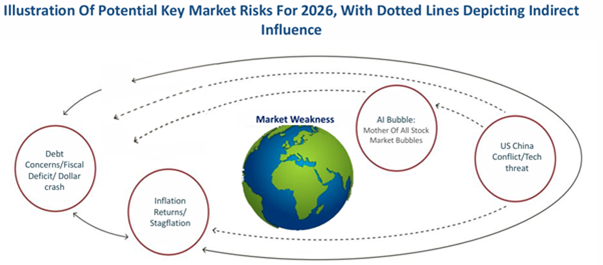
For investors, this marks a clear shift: returns will be driven not just by growth, but by policy choices, geopolitics, and capital flows.
Geopolitics: From Sanctions to “Conquest & Control”
The geopolitical environment in early 2026 reflects a shift toward more direct and interventionist foreign policy. Recent military actions in Venezuela and renewed strategic focus on Greenland signal a move beyond sanctions toward control over resource-rich and strategically critical regions.
At the same time, U.S. tariff issues and unresolved conflicts in the Gaza Strip, the Russia–Ukraine war, and tensions involving Iran continue to simmer. These flashpoints have implications for energy markets, global supply chains, defence spending, and investor confidence. For portfolios, this raises the probability of sudden risk events rather than gradual adjustments.
Monetary Policy: Easing, but with Constraints
Global monetary policy is at an important inflection point. While rate cuts have begun, uncertainty around inflation persistence and economic durability remains high. Markets will closely track the late-January 2026 U.S. Federal Reserve meeting for guidance on the pace of further easing.
In India, the Reserve Bank of India has also shifted toward supporting growth as inflation moderates. The February 2026 policy meeting will be critical in shaping expectations around liquidity and credit growth. Importantly, this phase represents a transition rather than a return to ultra-loose monetary conditions, especially given elevated global debt levels that limit policy flexibility.
FPI Flows:
A critical upside catalyst for Indian equity markets in 2026 if global risk appetite improves. India stands out as a relatively resilient economy, supported by strong domestic demand and improving earnings visibility, even as it remains exposed to global volatility. With the earnings cycle appearing to have bottomed out and valuation premiums versus emerging markets largely normalised, India is well positioned for a gradual recovery. However, global uncertainty, geopolitical risks, and unresolved trade issues continue to influence foreign investor sentiment, and any slowdown in consumption or earnings could weigh on markets. Investors will have to think beyond 2026 on equities though, and imagine how portfolios may look like after 3-5 years.
Global Oil Surplus: A Structural Tailwind to Watch for India in 2026
One of the most underappreciated macro positives for 2026 is the growing likelihood of a global oil surplus.
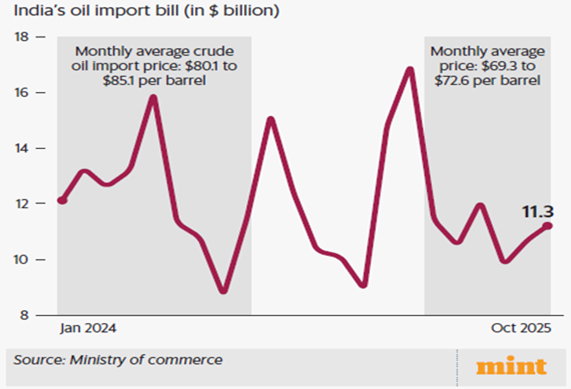
For India, lower crude prices are structurally positive. They help contain inflation, reduce the import bill, and improve the current account balance. While India’s dependence on oil imports will persist, softer oil prices act as a macro stabilizer and provide policymakers with greater room to manoeuvre.
Safe-Haven Role
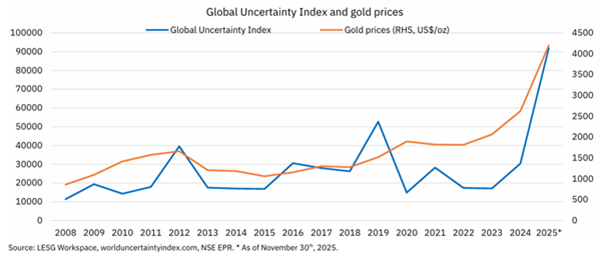
Gold’s strong performance in 2025 underscores how well the metal thrives in periods of uncertainty, and such conditions continue into 2026. As a result, gold remains a relevant hedge, offering protection against geopolitical risk, currency debasement, and financial stress. However, investors should be mindful that a sharp de-escalation in major conflicts or faster-than-expected disinflation could trigger a near-term pullback in gold prices. Also the sharp run up means that there are risks of sharp corrections at certain points.
AI, Green Tech, and Structural Opportunities
Structural shifts such as AI, green technologies, and new commodity cycles are creating fresh investment opportunities. While markets enter 2026 with pockets of excess optimism, AI is clearly moving from hype to real economic impact through productivity gains and new business models. Importantly, opportunities extend beyond large technology firms to the broader ecosystem. However, valuations will need to be kept in mind as these sectors are not cheap.
In summary, 2026 is shaping up as a year of moderate growth, policy transition, and elevated geopolitical risk. India’s domestic fundamentals remain relatively strong, but successful investing will require disciplined asset allocation, diversification, and a focus on long-term structural themes rather than short-term market narratives.
Disclaimers:
- Investment in securities market are subject to market risks. Read all the related documents carefully before investing.
- Registration granted by SEBI, membership of BASL and certification from National Institute of Securities Markets (NISM) in no way guarantee performance of the intermediary or provide any assurance of returns to investors.
- The information is only for consumption by the client and such material should not be redistributed.
- The securities quoted are for illustration only and are not recommendatory.
- Past performance is not an indicator of future performance.
- Please consult your investment advisor before investing.
- This material is for information and educational purposes only.
- Details are at https://planahead.in/disclaimers-disclosures/