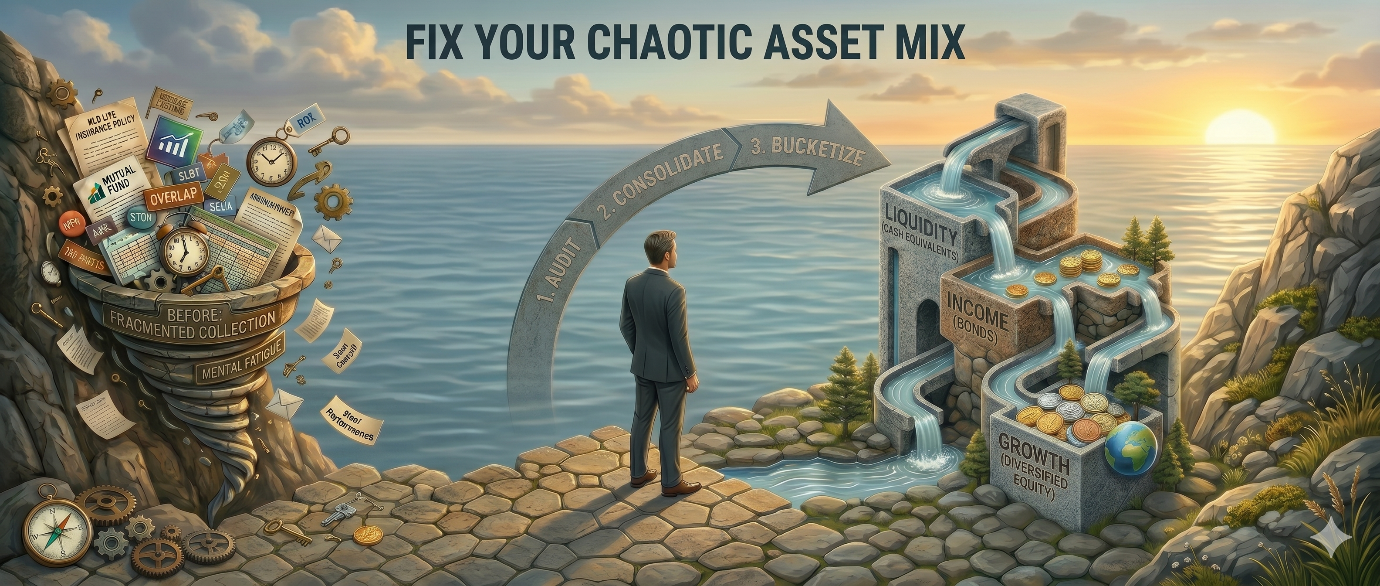
The Chaotic Asset Mix Problem
Many investors in their 40s and 50s reach a point where their portfolio no longer feels like a plan. It feels like a collection — of decisions made at different times, by different versions of themselves, for different reasons. This is the chaotic asset mix problem, and it is far more common than most investors realise.
How Do Portfolios Become Fragmented ?
It happens gradually. A fixed deposit opened when rates were attractive. A life insurance policy with a savings component taken on a family member’s suggestion. A PMS added for its track record, then another with a different strategy. Some direct equity bought during a dip. SIPs started across multiple fund houses, often duplicating the same underlying theme. Real estate purchased for good reason but now adding illiquidity the rest of the portfolio never accounted for. Each decision had a rationale. Together, they do not form a portfolio. They form a collection — and a collection is not a strategy.
The Real Cost of Clutter
The primary cost is mental fatigue — tracking multiple platforms, multiple providers and maturity dates. But the hidden costs run deeper. Overlap is one: investors running two or three PMS schemes alongside equity mutual funds may believe they are diversified, while actually being concentrated in the same names, paying different fees to multiple managers for the same privilege. Tax inefficiency is another — without a whole-portfolio view, strategic loss harvesting and redemption timing become impossible, and investors end up paying more tax than necessary. Most seriously, there is misalignment with life stage. A portfolio built at 38 may not be suited at 52 — too exposed to equity, too rigid in fixed deposits, and still carrying insurance policies delivering negligible returns.
The Transition That Needs to Happen
For investors approaching early retirement, the portfolio must stop being a return-chasing vehicle and become a cash-flow generating engine. This shift requires three things:
First, a complete audit — every investment listed in one place, with its current value, liquidity, tax status, and role clearly visible. Most investors have never done this fully. Forgotten policies, auto-renewed FDs, and underperforming PMS schemes are routine discoveries.
Second, rationalisation. Overlapping schemes consolidated. Legacy insurance-cum-investment policies evaluated for surrender value. Fixed deposits reviewed for whether another alternative debt structure would deliver better post-tax outcomes. The goal is not the highest return on each line item — it is coherence across the whole.
Third, bucket construction. A liquidity bucket covering twelve to twenty-four months of expenses in low-volatility instruments. An income bucket covering three to seven years of planned expenses in bonds or systematic withdrawal plans. A growth bucket in equity, with a horizon long enough to absorb market cycles. The discipline is leaving each bucket alone — the growth bucket untouched when markets fall, the liquidity bucket not tempted into equities during a rally. Buckets work because they separate the emotional biases.
The Tax Angle Cannot Be an Afterthought
Cleaning up a fragmented portfolio often surfaces a sequencing question: in what order should positions be exited? The answer is driven by tax outcomes across financial years, not by age of holding or performance alone. For investors in the higher tax brackets, thoughtful sequencing can meaningfully alter how much of the restructuring costs — or saves.
What Organised Wealth Actually Feels Like
An investor who has been through this process knows exactly what they hold and why. They know what their portfolio generates, which investments serve which purpose, and they are not anxious when markets fall — because their near-term needs are already secured.
The goal, for most investors, is not abstract wealth accumulation,it is enough, clearly organised, reliably generating what is needed, without constant management anxiety. That is not a modest ambition. It is exactly what a robust financial plan should deliver.
Disclaimers.
- Investment in securities market are subject to market risks. Read all the related documents carefully before investing.
- Registration granted by SEBI, membership of BASL and certification from National Institute of Securities Markets (NISM) in no way guarantee performance of the intermediary or provide any assurance of returns to investors.
- The information is only for consumption by the client and such material should not be redistributed.
- The securities quoted are for illustration only and are not recommendatory.
- Past performance is not an indicator of future performance.
- Please consult your investment advisor before investing.
- This material is for information and educational purposes only.
- Details are at https://planahead.in/disclaimers-disclosures/