


As investors increasingly look for strategies that deliver long-term outperformance without the emotional rollercoaster of stock picking, Factor Investing has emerged as a compelling middle ground between passive indexing and active management. But is it right for you?
Let’s explore the answer based on both market behaviour and empirical data.
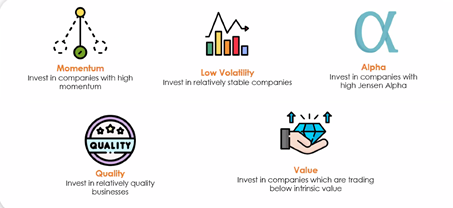
Every investor has a different approach when it comes to equity investments. Some chase higher returns, while others prioritize safety. The strategies below offer a range of options based on your goals and risk appetite.
Source: UTI AMC
If you’re an aggressive investor, styles like Momentum and Alpha might appeal to you. These focus on high-growth opportunities, though they often come with higher volatility.
On the other hand, conservative investors may prefer Quality and Low Volatility strategies, which aim to protect capital and provide steady returns, especially during uncertain markets.
Historically, Factor strategies have a well-documented track record of outperforming traditional indices like the Nifty 50 and Nifty 200 over long holding periods. While these factors may underperform during short-term market dislocations, their long-term wealth creation potential is supported by decades of global and Indian data.
Rolling Returns
| Index | Returns | |||
|---|---|---|---|---|
| 1 Year | 3 Years | 5 Years | 10 Years | |
| Nifty 200 Momentum 30 | 23 | 20 | 20 | 19 |
| Nifty 50 Value 20 | 19 | 18 | 18 | 15 |
| Nifty 100 Low Volatility 30 | 16 | 15 | 15 | 16 |
| Nifty Alpha 50 | 27 | 22 | 24 | 19 |
| NIFTY200 Quality 30 | 15 | 14 | 15 | 17 |
| Nifty 200 | 16 | 14 | 14 | 12 |
Source – Morningstar direct
Every factor goes through its cycle of outperformance and underperformance, as you can see below, winners keep changing. This constant rotation makes it incredibly difficult to be in the right factor at the right time.
Since timing the market or predicting trends can be challenging, multi-factor strategies that combine different investment styles help deliver more balanced and consistent returns.
| Rank | 2015 | 2016 | 2017 | 2018 | 2019 | 2020 | 2021 | 2022 | 2023 | 2024 | 2025* |
|---|---|---|---|---|---|---|---|---|---|---|---|
| 1 | Alpha 14.2% | Value 20.8% | Momentum 64.9% | Low volatility 6.3% | Momentum 7.8% | Alpha 50.4% | Momentum 75.8% | Value 16.6% | Value 57.9% | Alpha 32.7% | Low Volatility -5.1% |
| 2 | Momentum 10.2% | Equal Weight -5.2% | Alpha 64.0% | Quality 3.9% | Nifty 500 7.3% | Low Volatility 21.6% | Alpha 72.2% | Nifty 1.6% | Momentum 46.1% | Momentum 25.6% | Value -6.5% |
| 3 | Low Volatility 8.3% | Nifty 500 3.4% | Value 40.1% | Nifty 500 -2.8% | Alpha 7.3% | Quality 20.9% | Value 50.1% | Equal Weight -0.1% | Alpha 42.6% | Value 17.7% | Equal Weight -7.1% |
| 4 | Quality 2.2% | Low Volatility 1.2% | Nifty 500 35.5% | Equal Weight -9.5% | Quality 4.1% | Momentum 19.8% | Equal Wight 31.4% | Low Volatility -0.6% | Quality 30.7% | Equal Weight 16.3% | Nifty 500 -8.9% |
| 5 | Nifty 500 -0.9% | Quality 0.4% | Equal Weight 33.0% | Momentum -11.7% | Low Volatility 3.7% | Nifty 500 16.5% | Nifty 500 29.6% | Quality -3.5% | Low Volatility 30.5% | Nifty 500 14.9% | Quality -8.9% |
| 6 | Equal Weight -1.6% | Momentum -2.8% | Low Volatility 27.7% | Alpha -14.3% | Equal Weight 2.0% | Equal Weight 16.0% | Low Volatility 21.1% | Momentum -9.3% | Equal Weight 29.3% | Low volatility 11.0% | Momentum -21.3% |
| 7 | Value -10.1% | Alpha -10.8% | Quality 20.9% | Value -28.8% | Value -15.8% | Value 6.0% | Quality 19.7% | Alpha -15.1% | Nifty 500 25.2% | Quality 9.6% | Alpha -22.4% |
Source: ET Wealth Data as on 8th April 2025
One thing investors also need to note is that different factors outperform in different market phases:
In bearish or flat markets, Quality and Low Volatility tend to outperform by preserving capital.
In moderate uptrends, Momentum and Value begin to take the lead.
In strong bull markets, Value, Momentum, and Alpha-style factors usually deliver the best returns.
So the final question: “Is It Right for You?”
If you seek:
- Long-term outperformance over indices and better risk-adjusted performance
- Broad exposure across sectors and industries to achieve better risk distribution within a single fund.
- Rule-based, clearly defined, and publicly available stock selection process.
- Lower expense ratios compared to actively managed funds: a cost-efficient way to target outperformance.
- Disciplined and transparent approach to nullify emotional bias or inconsistent decision-making.
… then yes, factor Investing could be right for you.
It may not deliver instant gratification, but factor strategies reward the patient investor with consistent, efficient compounding. Factors can be used in addition to passive and active funds in a portfolio.
Disclaimers:
Investments in securities market are subject to market risks. Read all the related documents carefully before investing.
Registration granted by SEBI, membership of BASL and certification from National
Institute of Securities Markets (NISM) in no way guarantee performance of the intermediary or provide any assurance of returns to investors.
The information is only for consumption by the client and such material should not be redistributed.
The securities quoted are for illustration only and are not recommendatory.
This material is for information and educational purposes only.